

Stachybotrys chartarum: The Toxic Indoor Mould
Berlin D. Nelson, Professor, Department of Plant Pathology, North Dakota State University, Fargo (Berlin.Nelson@ndsu.nodak.edu)
Introduction

Natural Mould cleaning options
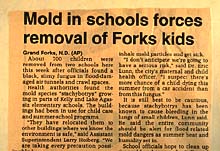
Fig. 1. An article from the Fargo Forum, May 1, 1997 (click image for larger view).
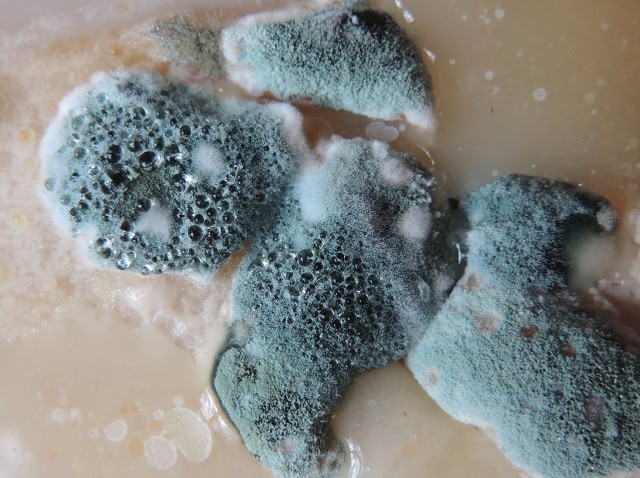
Stachybotrys chartarum is a fungus that has become notorious as a mycotoxin producer that can cause animal and human mycotoxicosis. Toxic black mould poses significant health hazards due to its mycotoxins, which can cause respiratory issues, especially in sensitive individuals. Indeed, over the past 15 years in North America, evidence has accumulated implicating this fungus as a serious problem in homes and buildings and one of the causes of the “sick building syndrome.” In 1993-1994, there was an unusual outbreak of pulmonary haemorrhage in infants in Cleveland, Ohio, where researchers found S. chartarum growing in the homes of sick infants. This incident increased the awareness of home/building moulds and brought this fungus to the immediate attention of the medical community. In recent years there has been a cascade of reports about toxic moulds in the national media. The New York Times Magazine, August 12, 2001, ran a front-page story on toxic mould. Newspaper articles (Fig. 1) such as “Fungus in ‘Sick’ Building” (New York Times, May 5, 1996) or “Mold in schools forces removal of Forks kids” (Fargo Forum, June 1997) are eye-catching news items. The nationally syndicated comic strip Rex Morgan ran a series on Stachybotrys, and television news shows have run entire programs on Stachybotrys contamination of homes. The fungus has resulted in multimillion-dollar litigations and caused serious problems for homeowners and building managers who must deal with the human issues and remediation.
As a mycologist, I have been advising public officials and the general public on the issues concerning indoor moulds. Our region experienced one of the greatest natural disasters of modern times when the Red River flooded in 1997. In Grand Forks, ND, alone, there were 9,000 flooded homes. There was an enormous need for information on the effects of the flood on human health in the Red River Valley. Because of the increasing awareness of moulds in indoor air quality, a coordinated effort by city, state and federal officials to provide information on mould prevention was undertaken. In my observations following the flood and in subsequent years of dealing with indoor mould issues, I have been impressed with the common occurrence and extensive growth of S. chartarum in homes and buildings damaged by floodwaters or other types of water incursions and the lack of knowledge by the general public and public and private institutions about this fungus. This review provides information on the fungus, its biologically active compounds, the history of the problem, the controversy about this fungus, and briefly comments on detection and remediation.
How to destroy Toxic Black Mould?
Where S. Chartarum Occurs Indoors
The spores of S. chartarum are in the soil and are introduced along with floodwaters or the dust and dirt entering with the water incursion. Also, building materials at the time of construction can have a coating of dust or dirt that contains S. chartarum. The fungus is most commonly found in homes or buildings which have sustained flooding or water damage from broken pipes, roof, wall or floor leaks, condensation, etc. Wet conditions are required to initiate and maintain growth. Porous surfaces like wood and drywall are particularly susceptible to mould growth, as traditional cleaning methods may not effectively eliminate mould from these surfaces. It is most common on the paper covering of gypsum wallboard, but can be found on wallpaper, cellulose-based ceiling tiles, paper products, carpets with natural fibres, paper covering on insulated pipes, in insulation material, on wood and wood panelling, and on general organic debris (Figs. 8 to 10). The paper covering fibreglass insulation is another area for growth (Fig. 11). The fungus can be hidden in the ceiling, walls or floors with no or little visible evidence within the interior of the room. The spores, however, can contaminate the interior of the room through holes and cracks in the building materials (aided by negative pressure) or be transported via the air handling system. It can also be found growing in ducts if there is organic debris. Condensation due to poor design or faulty heating, ventilation, and air conditioning systems can promote the growth of the fungus. The fungus will usually produce large amounts of conidiophores and conidia giving the substrate a black appearance that can be slightly shiny when fresh and powdery when dry. I have observed the fungus growing profusely on the paper covering of gypsum wallboard within a week after floodwater was drained from a building.
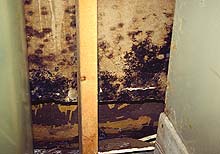
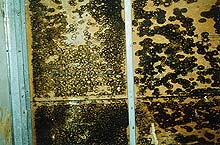
Fig. 8. S. chartarum growing on the backside of water damaged gypsum wallboard (i.e. sheetrock) behind a basement shower stall. A high water table caused flooding in the basement (click image for larger view).
Fig. 9. Heavy growth of S. chartarum and some other fungi on gypsum wallboard in a flooded school basement. This growth occurred about one week after the flood. It was removed before remodelling (click image for larger view).
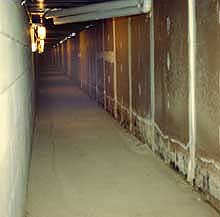
Fig. 10. Growth of S. chartarum along the base of gypsum wallboard (covering the insulation on a concrete wall) inside of a ventilation tunnel around the base of an elementary school. Notice the black areas at the base of the right sidewall. The spores were being drawn up into the classrooms, thus the entire gypsum wallboard had to be replaced and the tunnel sanitized. The tunnel was flooded to about 6 inches deep (click image for larger view).
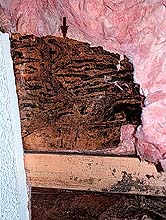
Fig. 11. Growth of S. chartarum on the paper covering (arrow) of fibreglass insulation. This paper was touching the paper covering of the gypsum wallboard ceiling, resulting in excessive growth of the fungus. The building had a roof leak that dripped onto the insulation and ceiling. The white ceiling is on the left. The paper is torn away from part of the fibreglass insulation (click image for larger view).
The above article is taken from https://web.archive.org/web/20050828033934/http://www.apsnet.org/online/feature/stachybotrys/ which I just loved reading and sharing with my WordPress site.
Introducing: Mr Meticulous Cleaning Services for Mould Removal
Mr Meticulous Cleaning Services has been looking after you and your friend’s and families’ homes and offices throughout Australia since 1995. We engage highly trained and skilled cleaners who take great pride in their results. Our team specialises in end of lease cleaning and commercial cleaning but produce a high level of professionalism and cleanliness in any facet of the industry.
We offer services for cleaning your home on a weekly or a fortnightly basis, for one-off deep cleaning services or end of lease cleans. Homes aren’t the only place we clean; end of builders cleans, or shop fit-out cleaning services are available. We understand all the work that goes into a building project and the last thing you want is for messy surprises at hand over. Our team is professional, reliable, and dedicated and will make sure your project is left spotless. Additionally, professional mould remediation services are crucial to ensure thorough mould removal and prevent potential health hazards.
End of Lease Cleaning and our Bond Cleaning Service is something that we have become well known for. We have completed 1000’s of end of lease cleaning jobs for individuals and real estate agencies. Our Bond Cleaning Service not only offers general cleaning, but we also offer:
-
Mould removal
-
Oven – Stovetop and Rangehood detailing
We look after everything for your end of lease cleans or Bond cleans so that we can guarantee your Bond is returned. Email Enquiries welcomed
Mr Meticulous Cleaning Services has a cleaning team near you. We charge only after the service and will correct, fix or discuss any situation. We offer seven days a week cleaning, and we’re 5 Star rated on Google, the most powerful and trusted search engine for reviews and social proof that I would put my trust in, and having a 100 % money-back guarantee, you just can not go wrong. We are accountable; we are on all social media platforms. We are contactable, widely known, verified and trusted. We were cleaning in the ’90s and now the 000’s, and we will continue into the future and beyond.
Marc Hamilton has been the owner since its inception in 1995. Marc started and will continue to be the face and contactable person within this business. Always available. We are not a faceless, contactless, unknown person behind any website geared towards share prices and company earnings. Both Marc and our team of dedicated cleaners value working for you and hold a personal commitment and interest to provide the best service possible. We are in this together. You are welcome to contact us on 0402 317 313 or office@mrmeticulous.com.au.
MOULD SPORES AND MILDEW ELIMINATION
End of Lease, Bond Cleaning, Deep Cleaning
Introducing: Mr Meticulous Cleaning Services
Mr Meticulous Cleaning Services has been looking after you and your friend’s and families’ homes and offices throughout Australia since 1995. We engage highly trained and skilled cleaners who pride their results. Our team specialises in end of lease cleaning and commercial cleaning but produce a high level of professionalism and cleanliness in any facet of the industry.
We offer services for cleaning your home weekly or fortnightly, for a one-off deep cleaning service, or end of lease cleans. Homes aren’t the only place we clean; end of builders cleans or shop fit-out cleaning services are available. We understand all the work that goes into a building project, and the last thing you want is for messy surprises at hand over. Our team is professional, reliable, and dedicated and will ensure your project is left spotless.
End of Lease Cleaning and our Bond Cleaning Service is something that we have become well known for. We have completed 1000’s of end of lease cleaning jobs for individuals and real estate agencies. Our Bond Cleaning Service not only offers general cleaning, but we also offer:
-
Deep Cleaning
-
Mould removal
-
End of Builders Cleaner
-
Steam Cleaning Carpets
-
High-pressure cleaning
-
Event or Party cleaning
-
Window and Glass cleaning
-
Oven – Stovetop and Rangehood detailing
To effectively kill mould and prevent its regrowth, we use specific products like clove oil and bleach. While bleach may kill surface layers of mould, true mould removal requires deeper cleaning methods and the use of proper mould-killing chemicals, addressing both health and safety concerns.
We look after everything for your end of lease cleans, or Bond cleans so that we can guarantee your Bond is returned. Email Enquiries welcomed
Mr Meticulous Cleaning Services has a cleaning team near you. We charge only after the service and will correct, fix or discuss any situation. We offer seven days a week cleaning, and we’re 5 Star rated on Google, the most powerful and trusted search engine for reviews and social proof that I would put my trust in, and having a 100 % money-back guarantee, you can not go wrong. We are accountable; we are on all social media platforms. We are contactable, widely known, verified and trusted. We were cleaning in the ’90s and now the 000’s, and we will continue into the future and beyond.
Marc Hamilton has been the owner since its inception in 1995. Marc started and will continue to be the face and contactable person within this business. Always available. We are not a faceless, contactless, unknown person behind any website geared towards share prices and company earnings. Both Marc and our team of dedicated cleaners value working for you and hold a personal commitment and interest to provide the best service possible. We are in this together. You are welcome to contact us on 0402 317 313 or office@mrmeticulous.com.au.
At Mr Meticulous Cleaning Service, we offer everything from Oven, Windows, Blinds, Carpet Steam Cleaning, Spring cleaning, Party Cleaning, Bond Cleaning, exit lease cleaning, Builders cleans, Your Cleaners can be weekly, daily, fortnightly, monthly, or a one-off cleaning service. Just let us know what you require.NDIS registered for participants and is ready to look after you or your loved ones in the NDIS self-managed or Plan managed DEEP cleaning for you – this is how you should be doing it. We will supply you with 5-star service and eliminate all the issues associated with having cleaners at your premises. We accept CASH – ACCOUNT and CREDIT CARD. A highly trained and skilled team of cleaners who take great pride in the results they achieve. Our end of lease cleaners is the best. End of Lease Cleaning and the Bond Cleaning Service is something that we have become well known for. We have completed 1000’s of end of lease cleaning jobs for individuals and real estate agencies. We see the degree of perfection an end of lease cleaning is expected. Let us look after you and any cleaning needs, or just reach out and see how we can help you. Marc 0402 317 313 Mr Meticulous Cleaning office@mrmeticulous.com.au https://mrmeticulous.com.au/get-a-quote-free-obligation-free/
Understanding Mould Problems
Mould problems can arise in any home, regardless of age or location. Mould growth is often caused by excess moisture, poor ventilation, and high humidity levels. Understanding the root causes of mould problems is crucial to effectively removing mould and preventing its recurrence. Mould can grow on various surfaces, including walls, ceilings, floors, and furniture, and can cause significant damage to property and health. When left unchecked, mould growth can lead to structural damage and contribute to respiratory issues, allergic reactions, and other health problems. Identifying and addressing the sources of moisture and ensuring proper ventilation are key steps in managing mould problems.
What is Black Mould and is it Dangerous?
Black mould, also known as Stachybotrys chartarum, is a type of toxic mould that can cause serious health issues. It is characterized by its blackish-green appearance and typically grows on moist, cellulose-rich surfaces such as wood, paper, and drywall. While black mould is not typically considered a deadly fungus, it can cause health problems, particularly in individuals with allergies or weakened immune systems. Prolonged exposure to black mould can trigger allergic reactions, respiratory problems, and skin irritation. Symptoms of black mould exposure may include coughing, sneezing, eye irritation, and in severe cases, chronic fatigue and headaches. It is essential to address black mould growth promptly to minimize health risks.
How Mould Spreads
Mould spreads through airborne spores that can be carried by air currents, clothing, and pets. These mould spores can also be transported through water and can grow on surfaces that are exposed to moisture. Once mould spores land on a suitable surface, they can begin to grow and multiply, leading to extensive mould growth. Mould can also spread through contact with contaminated surfaces, making it essential to take precautions when handling mouldy materials. Ensuring that areas prone to moisture are kept dry and clean can help prevent the spread of mould spores and subsequent mould growth.
Mould Prevention Tips
Preventing mould growth requires maintaining a dry and well-ventilated environment. Here are some mould prevention tips:
-
Regularly inspect areas prone to moisture, such as bathrooms and kitchens, for signs of mould growth.
-
Fix any water leaks or damage promptly to prevent moisture buildup.
-
Use a dehumidifier to maintain a humidity level below 50%.
-
Improve ventilation by opening windows, using exhaust fans, and installing a ventilation system.
-
Regularly clean and disinfect surfaces, especially in areas prone to moisture.
-
Use mould-resistant products, such as paint and caulk, to prevent mould growth.
By following these tips, you can significantly reduce the risk of mould growth in your home and maintain a healthier living environment.
Safety Precautions
When handling mould, it’s essential to take safety precautions to prevent exposure to mould spores and mycotoxins. Here are some safety precautions to follow:
-
Wear protective gear, including gloves, masks, and eyewear, when handling mould.
-
Use a HEPA-filter vacuum cleaner to prevent mould spores from becoming airborne.
-
Contain the mouldy area to prevent mould spores from spreading to other parts of the home.
-
Avoid touching or handling mouldy materials, as this can cause mould spores to become airborne.
-
Keep children and pets away from mouldy areas to prevent exposure to mould spores.
By adhering to these safety measures, you can protect yourself and your family from the potential health risks associated with mould exposure.